Watching with a Purpose
A player has won a point by changing direction. The replay seems to show the moment clearly: the open court, the contact, the opponent moving the wrong way. But what should a team learn from it—and what should it refuse to assume?
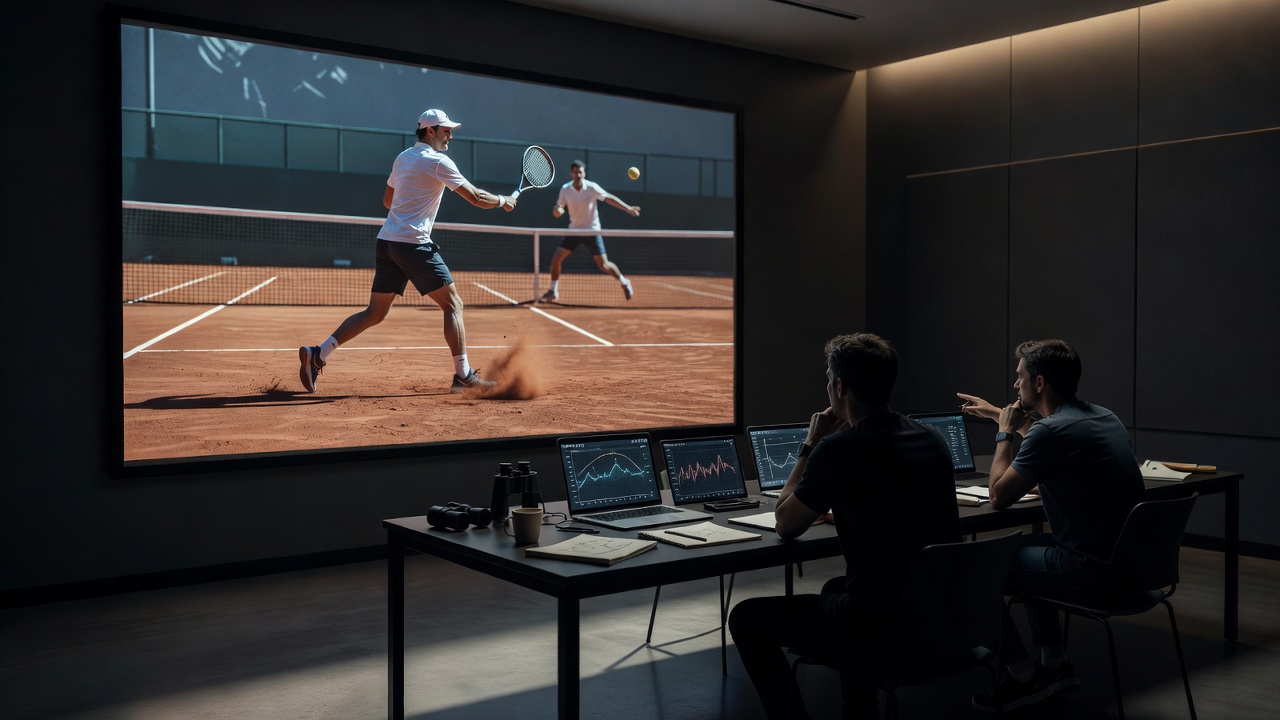
Begin with a question worth answering
Analysis can become a pile of clips if no one decides what they are for. A more useful process begins with a question tied to the player’s next task. Does the player create an opportunity to attack after a particular return? Are they recovering too far toward one side? Does a serve pattern produce the intended first-ball position? These questions are specific enough to guide observation while leaving room for the evidence to disagree.
The question might come from a coach’s court observation, the player’s own impression or a recurring situation in competition. It should be agreed with the athlete, not simply imposed by a screen full of statistics. A player who understands why a sequence is being reviewed is more likely to connect it to practice. They can also correct a mistaken interpretation: perhaps the shot was an intentional reset, not a missed attack.
Before collecting more information, define what would count as a useful answer. Sometimes a tally of a few repeated situations is enough. Sometimes carefully chosen video examples are more illuminating. More data is not automatically better; a report should reduce uncertainty enough to help someone make a decision.
Describe what the picture can show
Video allows a moment to be paused, compared and revisited. Depending on the camera position, it may help show court location, movement timing, shot direction or opponent recovery. A single view can also mislead. Perspective changes apparent distance, the frame may miss early movement and a close crop can remove tactical context. Teams should be clear about what the recording can and cannot support.
Technology that labels shots or tracks movement can make review faster, but automated classifications still depend on the recording and its underlying assumptions. A result may be wrong, incomplete or simply irrelevant to the question. A human reviewer can check samples and discuss uncertainty with the player. Tools are most useful when they save time or reveal a pattern that can then be examined thoughtfully.
Match statistics have similar limits. Serve percentages, errors and rally length describe selected events in a particular way. They do not necessarily explain why an event occurred. A number can suggest where to look; it should not become the entire account of a player’s performance.
Review the clip as evidence, then invite the player to supply the context beyond its edges.On match observation
Keep review proportionate
A short session focused on two or three patterns may serve a player better than an exhaustive review of every point. Teams can select examples that contrast: a situation that worked, one that did not and perhaps a borderline case. Ask the player what they noticed before sharing the analyst’s view. This order can reveal whether the training question is tactical, technical, perceptual or related to how information was communicated.
Review should also respect attention and recovery. Immediately after competition, a tired or disappointed player may not want a detailed critique. A team can agree in advance on a simple debrief, then schedule a fuller analysis when the athlete is ready. The aim is not to delay learning indefinitely; it is to choose a moment when the player can take part in it.
Fair comparison matters. An opponent’s different style, a change of surface, weather or match context may affect the pattern. Comparing performance across events without accounting for conditions can produce an overly confident conclusion. Analysts can note contextual factors and keep their language precise: “In these observed points…” is often more honest than “You always…”
From observation to practice
Analysis earns its place when the result changes a useful conversation or next action. If review suggests that a player sees a short ball late, a coach might build a drill around an early recognition cue. If a return position leaves an opponent’s preferred lane open, practice can test a different starting position and measure its trade-offs. A physical preparation specialist may help explore the movement demand, while the coach safeguards the tactical meaning.
Each change should remain testable. The team can ask whether the player recognised the cue sooner, maintained balance or chose an appropriate target. It need not use sophisticated technology to notice progress. A small number of comparable observations, alongside the player’s account, may be enough to decide whether to continue, adjust or abandon the idea.
After a few practice sessions, return to the original question. Did the pattern appear again in competition? Did the proposed solution help, create a new vulnerability or make no visible difference? This loop prevents analysis from turning into one-way advice. The plan should be open to revision as the player and opposition change.
Privacy, consent and good handling
Match footage and performance notes can be personal information, especially when they identify a player or reveal health, development or training details. A centre should explain why it collects material, how it is stored, who can access it and when it is deleted. Consent and appropriate access controls should be treated as part of responsible analysis, not administrative clutter.
Players should be able to ask for the purpose of a recording and understand whether it will be shared beyond the immediate support team. For young athletes, guardians and relevant safeguarding processes may also need consideration. The correct arrangements depend on context and applicable requirements; a performance analyst should not assume that a camera may be used simply because it is available.
Return to the point-winning change of direction. The replay can show the ball’s path and the opponent’s recovery. It may help the team ask a better question about recognition, position or choice. It cannot settle every question about the player. Analysis is at its best when it makes the next conversation more precise while leaving room for human judgment.