One Plan across the Team
The player reaches the ball, changes direction and wins the point. That moment may involve a coach’s tactical language, a conditioning plan, observations from match review and the athlete’s own judgment. Coordination is the work of making those contributions fit without pretending they are the same.
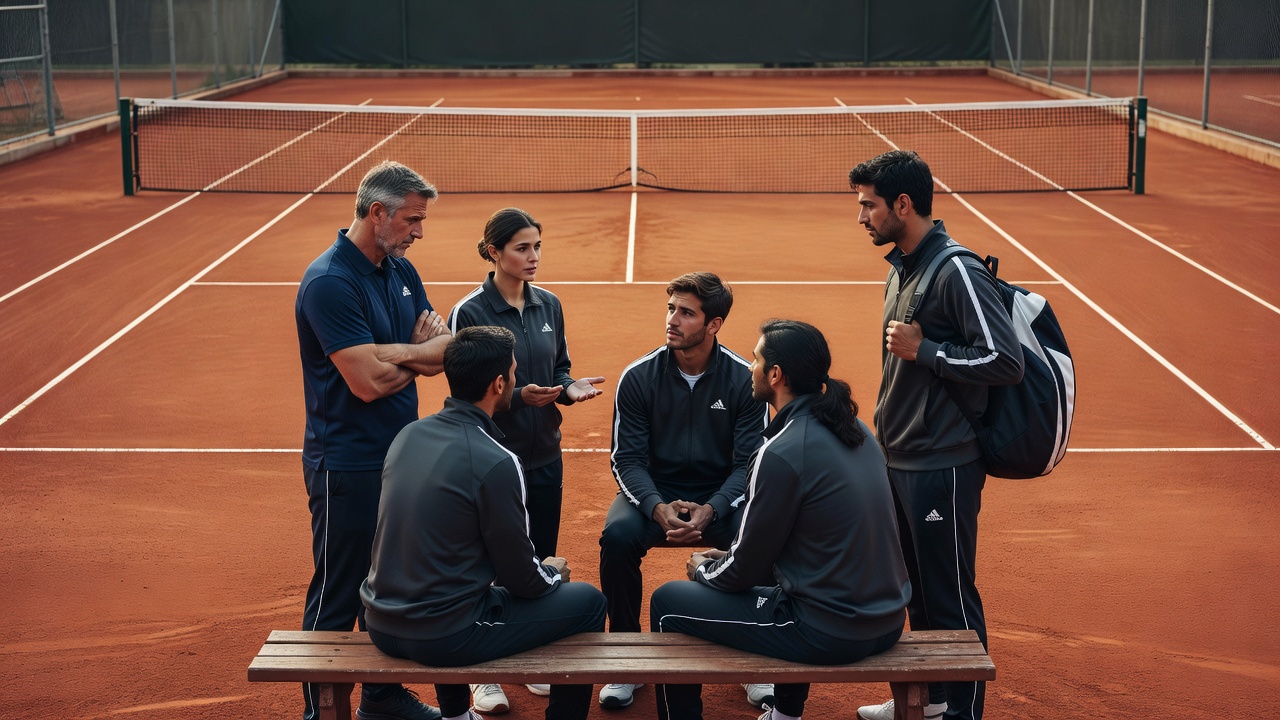
Start with the player’s question
Teams can gather around a player and still fail to work together. A coach may focus on a tactical pattern, a fitness specialist on workload, an analyst on a statistical trend and a clinician on a health concern. Each view may be reasonable. Without a shared question, the athlete can end up with competing priorities and no clear sense of what to do next.
A useful plan begins with what the player is trying to solve. Perhaps they want to attack a short ball more confidently late in a match. The group can then establish what each person contributes: the coach defines the tactical situation, the analyst checks how often and in what context it arises, the fitness specialist considers the physical demands, and the player describes what they notice. The team need not meet for every decision; a short exchange can align the next session.
Shared purpose is not a demand for agreement on everything. Professionals may interpret the evidence differently, and a player may not want to follow a particular suggestion. The value lies in making those differences clear, exploring their implications and avoiding hidden assumptions. The player remains a participant in the plan rather than a recipient of instructions passed between adults.
Clarify roles before pressure builds
In an organised environment, responsibilities are understandable. The coach leads tennis instruction; a suitably qualified strength and conditioning professional develops physical capacities; an analyst supports observation and interpretation; clinicians provide care within their professional scope. One person may hold several roles, especially in a smaller programme, but that does not remove the need to be clear about which hat they are wearing.
Role clarity helps prevent advice from drifting beyond expertise. A coach can notice that a player is moving differently, but should not diagnose an injury based on a single observation. A fitness specialist can adapt exercise around a reported concern while helping the player access appropriate clinical care. An analyst can describe a pattern without presenting a statistic as a medical explanation.
Consent and confidentiality belong in this structure. Staff should agree what information can be shared and for what purpose. A player may be comfortable discussing training load with a coach but not want personal health information circulated widely. A centre should have a clear way to handle sensitive information and should explain it in language the athlete understands.
One plan does not mean one voice. It means the player can hear how the voices relate.On team communication
Make communication small and regular
Coordination does not need to turn into an administrative project. Before a key training week, a short check-in can identify competition dates, the main court objective, relevant physical work and any constraint the team should respect. After sessions, a brief note can capture what was completed and what changed. Such a rhythm reduces the chance that staff unknowingly prescribe conflicting demands.
When a player travels or works with an external coach, a concise handover can help. It might contain the current training aim, recent observations, any agreed adjustment and the date for review. It should not become an unfiltered dossier. Share what is necessary, with permission, and make sure the athlete knows what has been passed on.
Digital platforms can make schedules and notes easier to access, but they do not create good communication automatically. A shared folder full of outdated documents is less useful than a current, readable plan. Teams should decide who updates records and how they signal a change. Players should have a way to ask for clarification rather than guessing which version is current.
Protect the athlete’s attention
Multiple specialists can offer rich support, but too many simultaneous cues can burden the player. A training session with one main objective is often easier to understand than a sequence in which every professional adds a separate target. Staff can agree which information is essential now and which can wait. That does not dismiss secondary concerns; it gives them a suitable place in the schedule.
Check-ins should ask about the athlete’s experience, not only whether they complied. Did the drill feel connected to the match? Was the load appropriate? Did the instructions conflict? The answers may reveal a practical problem: a session is scheduled too close to travel, feedback arrives too quickly, or an objective is described in language the player does not use. The team can adjust without framing every difficulty as a motivation issue.
Young players need particularly thoughtful coordination. Their development includes school, family, friendships, physical growth and changing interests. A well-designed programme should consider those contexts and follow suitable safeguarding practice. Training ambition is not a reason to ignore a young person’s wider life or to leave them out of decisions affecting them.
Review the plan, not just the player
After a block of work, the team can review whether its assumptions were sound. Did the player recognise the tactical cue more consistently? Did the physical preparation fit the court demand? Did match observations confirm the concern or point elsewhere? Was communication timely enough for the player to act on it? These questions evaluate the support system as well as the athlete’s performance.
Not every plan will produce the expected result. An opponent may alter a pattern, a tournament may interrupt training, or an initial explanation may prove wrong. A coordinated team treats that information as a reason to update its thinking, not as evidence that the player failed. Clear notes make it easier to remember why a decision was made and when it should be reconsidered.
For anyone assessing a performance centre, ask who coordinates the team and how the player is involved. Ask what happens when specialists disagree, how information is protected and how a plan changes around competition or health. A thoughtful answer should describe a process rather than promise perfect alignment.
The point began with one athlete making one choice. Behind it may be many people, but the support is meaningful only if it helps the athlete understand and prepare for that moment. A shared plan leaves room for specialist judgment, honest uncertainty and the player’s own voice.